
Quick Answer: on the numbers that matter to most Australian adult vapers, a quality disposable bought in small multi-order batches is cheaper per week than a refillable setup until your usage climbs past roughly 250–300 puffs a day — and the single biggest saving available on our shelf is not the multi-pack itself, it is clearing the A$199 free-shipping threshold. At 250 puffs a day, an ALIBARBAR INGOT 9000 at A$49.90 works out to roughly A$9.70 a week, or about A$13.20 a week all-in if you order one device at a time and pay the flat A$18 shipping each round. A refillable pod kit can beat that at heavier use because bottled liquid is cheap per millilitre — but it carries upfront hardware cost, coil replacements and more things that can go wrong. This article walks through the actual arithmetic using live prices from this store, so you can substitute your own numbers and see where you land.
Why Cost Per Puff Beats Sticker Price
Most people compare devices by the number on the price tag. That is the wrong first sort. A SP2 12000 at A$39.90 and a single ALIBARBAR INGOT 9000 flavour page at A$49.90 are ten dollars apart on the shelf, but one is rated for 12,000 puffs and the other 9,000. Once you divide price by the rated puff count, the ranking changes completely.
Here is the cost per 1,000 rated puffs across the main lines we stock (single-unit prices, before shipping):
- SP2 12000 — A$3.33 per 1,000 puffs. A$39.90 for a 12,000-puff rating, the lowest unit cost on our shelf.
- ALIBARBAR Swirl 13000 — A$4.61 per 1,000 puffs. A$59.90 for 13,000 rated puffs on the Swirl 13000 page.
- ALIBARBAR TEQ 12000 — A$4.16 per 1,000 puffs. A$49.90 for 12,000 puffs on the TEQ hub page.
- Tomoro Max 15000 — A$4.66 per 1,000 puffs. A$69.90 for 15,000 rated puffs.
- IGET One 12000 — A$4.74 per 1,000 puffs. Listed at A$56.90 on the IGET One hub page.
- IGET Bar Pro 10000 — A$4.99 per 1,000 puffs. A$49.90 for 10,000 puffs on the Bar Pro hub page.
- ALIBARBAR INGOT 9000 — A$5.54 per 1,000 puffs. A$49.90 for 9,000 puffs; you pay a small premium for the flavour range, which is the deepest on the site — see the INGOT 9000 flavours guide.
Two honest caveats before you treat these as gospel. First, puff ratings are manufacturer figures measured under standardised lab draws; your actual count depends on how long and how hard you draw, and most people land somewhere below the label. Second, none of these figures include shipping — and shipping, as you will see in a moment, is where casual buying quietly destroys your per-puff advantage.
The A$18 Shipping Line Changes Everything
We charge a flat A$18 for delivery anywhere in Australia, and shipping is free once your order passes A$199. Orders placed on weekdays before 2:30pm AEST go out the same day and typically arrive in 3–7 days, in sealed, batch-coded units. Those are the facts on every product page. Now look at what they do to the math.
- One INGOT 9000 at a time — A$67.90 delivered. A$49.90 plus A$18 shipping. Your effective per-device cost jumps 36 percent, and your cost per 1,000 puffs climbs from A$5.54 to A$7.54.
- Four singles at once — A$199.60 delivered. That clears the free-shipping threshold by twenty cents, so the delivery fee disappears entirely.
- The fourth device costs you A$31.90, not A$49.90. Going from three singles (A$149.70 + A$18 = A$167.70) to four singles (A$199.60, free shipping) adds just A$31.90 to your total. That is the cheapest device you will ever buy from us.
If you are a one-device-at-a-time buyer, the honest weekly figure is device cost plus amortised shipping. At 250 puffs a day, one INGOT lasts about 5.1 weeks, so the A$18 fee adds roughly A$3.50 a week. That is the hidden tax on impatience, and it is worth more than any multi-pack discount on the site.
The Multi-Pack Myth: Where the Real Saving Is
People assume bulk packs are where the discounts live. On our shelf, they mostly are not — and pretending otherwise would be doing you a disservice. Here are the live numbers for the INGOT 9000 multi-packs:
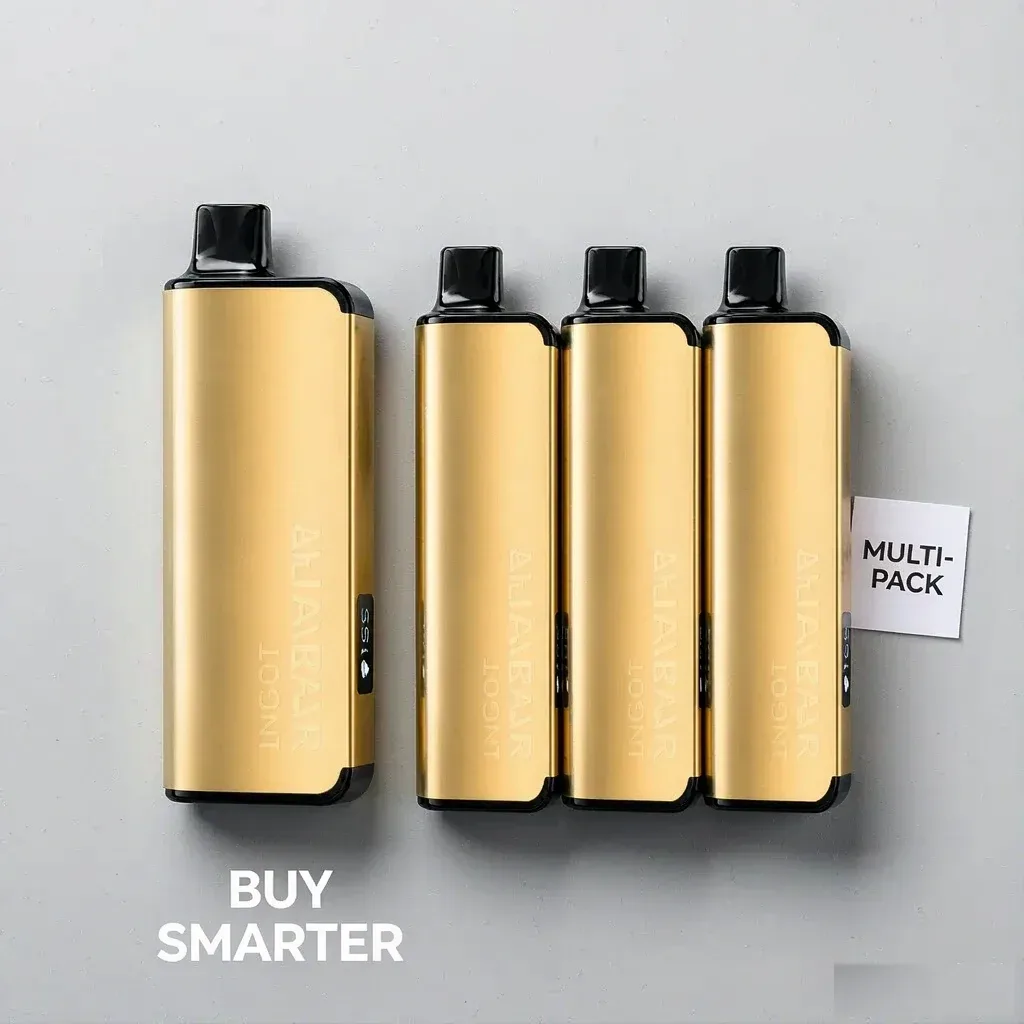
- 3-pack — A$168.00 on the INGOT 9000 3-pack page, which is A$56.00 per device — more than buying three singles (3 × A$49.90 = A$149.70). Worse still, A$168 alone does not clear the A$199 threshold, so you pay shipping on top: A$186 delivered, or A$62 per device. This pack only makes sense if you add something else to the order.
- 5-pack — A$245.00 on the INGOT 9000 5-pack page, which is A$49.00 per device and qualifies for free shipping outright. Versus five singles (A$249.50, also free shipping), you save A$4.50.
- 10-pack — A$490.00 on the INGOT 9000 10-pack page, again A$49.00 per device — A$9.00 less than ten singles.
- 20-pack — A$989.00 on the INGOT 9000 20-pack page, A$49.45 per device — A$9.00 less than twenty singles.
So the pattern is clear: the multi-packs trim a few dollars and guarantee free shipping, but the large saving — the A$18 fee and the A$31.90 fourth-device effect — comes from structuring any order to clear A$199. A practical habit: if you go through roughly one device a month, a quarterly order of four singles costs A$199.60 delivered, versus A$271.60 if you bought them one at a time with shipping each round. That is A$72 a year saved by changing nothing except when you click buy.
Everyday lines worth checking before you checkout
If pure cost per puff is your sorting rule, the AU Vapes shelf holds the value end of the range: the SP2 12000 at A$39.90 and the Swix 9000 at A$45.90. The Tomoro Max 15000 at A$69.90 and the Swirl 13000 at A$59.90 sit above them on sticker price but land mid-table on per-puff cost. Browse the full range on the shop page before settling on one line.
What a Refillable Actually Costs: a Formula, Not Folklore
We do not sell refillable hardware or bottled liquid, so we will not pretend to quote you our prices — there are none. What we can do is give you the formula serious buyers use, and one clearly-labelled worked example so you can plug in prices from your own local retailer and check the result yourself.
The honest weekly cost of a refillable setup is:
- Device cost ÷ realistic lifespan in weeks. A starter kit might run A$40–A$60 and last a year or more if you do not lose it or break it — so perhaps A$1 a week, if it truly lasts.
- Plus pods or coils ÷ replacement interval. Pods and coils are consumables; budget their price over how long each one actually lasts you, not the optimistic figure on the box.
- Plus liquid cost per week. Bottled liquid is where refillables win: the per-millilitre cost is far below sealed devices, and it scales almost linearly with use.
- Plus your time. Refilling, priming, cleaning, charging, and the occasional leak or burnt coil. It is a real cost, even if it never appears on a receipt.
A worked example — clearly labelled as illustrative
Take a hypothetical kit at A$50 lasting 52 weeks (A$0.96/week), replacement pods at A$5 each lasting a fortnight (A$2.50/week), and a A$30 bottle of liquid lasting three weeks at moderate use (A$10/week). Total: about A$13.50 per week. Compare that with the A$9.71 weekly disposable figure at 250 puffs a day (device only) or A$13.20–A$13.30 all-in with shipping amortised — and the two systems are, at that usage level, roughly a wash. These kit figures are illustrative estimates for demonstration only; actual Australian retail prices vary widely, and we do not sell or warrant this gear. The point of the exercise is the method, not the specific numbers.
Break-even: when does the refillable win?
Because liquid dominates a refillable's running cost and liquid is cheap per puff, the refillable's advantage grows with use. A reasonable rule of thumb from the formula: at light use (under 150 puffs a day), a disposable from our value lines usually costs less per week than a maintained kit, because the kit's fixed consumables spread thinly. Around 250 puffs a day the two converge. Past 300 puffs a day, the per-puff economics of bottled liquid generally pull ahead — assuming you actually maintain the kit and do not abandon it in a drawer after a burnt coil. There is also a failure-mode asymmetry worth weighing: a disposable that dies early costs you one device; a refillable that dies early can cost you the whole kit.
Cost Per Week at Four Usage Levels
Here is the disposable side of the ledger worked through at four realistic daily-use levels, using the INGOT 9000 at A$49.90 (9,000 rated puffs) and assuming you get the label count — which, as noted, is optimistic; scale accordingly:
- 150 puffs/day (light) — about A$5.80 a week. 1,050 puffs a week means one device lasts roughly 8.6 weeks.
- 200 puffs/day (moderate) — about A$7.80 a week. 1,400 puffs a week means roughly 6.4 weeks per device.
- 250 puffs/day (regular) — about A$9.70 a week. 1,750 puffs a week means roughly 5.1 weeks per device. Add about A$3.50 a week if you order one device at a time with shipping.
- 300 puffs/day (heavy) — about A$11.60 a week. 2,100 puffs a week means roughly 4.3 weeks per device.
Swapping the same spend onto the TEQ line — same A$49.90, 12,000 rated puffs — drops the regular-user figure to about A$7.30 a week, and the SP2 12000 at A$39.90 drops it to about A$5.80. If your usage is steady and predictable, choosing the higher-rated device is the cheapest upgrade available; if it is not, our guide on how long a 9,000-puff vape actually lasts covers how to read the signs before you reorder.
Hidden Costs on Both Sides
Sticker price and liquid maths never tell the whole story. Here is what each system hides in the fine print:
- Disposable: shipping fragmentation. The A$18 flat fee turns a cheap single into an expensive habit if you order impulsively. Batch your orders.
- Disposable: flavour drift. Committing to a 20-pack of one flavour is only smart if you genuinely still love it by bar fifteen. If you are unsure, the flavours guide is a better starting point than a 20-unit leap of faith.
- Disposable: counterfeit risk off-site. Every unit we ship is sealed and batch-coded; grey-market sellers rarely offer that, and a fake device is the most expensive kind of cheap.
- Refillable: consumable creep. Pods, coils, cotton, spare glass — small purchases that never feel large individually and quietly add up monthly.
- Refillable: failure clusters. Burnt coils, leaking tanks and dead batteries tend to arrive together, and each failure costs more than a single disposable.
- Both: impulse upgrades. A new device generation every few months resets either budget. The Bar Pro vs IGET One comparison is a good example of why the upgrade is often smaller than it looks.
Which One Is Cheaper for You? Three Profiles
Cost advice is useless without a usage profile attached, so here is the same arithmetic sorted by the three buyers we most often hear from:
- The social vaper (under 100 puffs a week). A single cheap disposable lasts months at this rate, and even with shipping, the annual cost is under A$120. A refillable kit's upfront cost and consumables would likely sit unused and unpaid-off. Disposables win clearly.
- The steady daily vaper (150–250 puffs a day). This is the contested middle. Batching orders to clear A$199 and choosing a 12,000-puff line like the TEQ or SP2 keeps disposables around A$6–A$10 a week delivered. A well-maintained refillable lands in the same band. Choose on convenience and reliability, not price — the price difference is noise here.
- The heavy vaper (300+ puffs a day). Consuming a 12,000-puff device every two to three weeks means A$20+ a week on disposables. Bottled liquid's per-puff cost advantage finally has room to show, provided the kit survives. If you stay with disposables at this level, the 20-pack at A$989 plus free shipping is the least-bad structure — about A$9.30 a week across ten weeks of use at 300/day.
If You Stay With Disposables: Five Concrete Ways to Spend Less
None of these require switching systems — they are just buying habits that respect the arithmetic above:
- Order in fours, not ones. Four singles (A$199.60) clears free shipping; the marginal cost of the fourth device is A$31.90. One batch a month beats four solo orders by about A$50 a month.
- Skip the 3-pack unless you top up the cart. At A$168 it misses the free-shipping threshold and lands at A$62 per device delivered — the worst value on the INGOT shelf. Add a fourth item or buy singles.
- Match the device rating to your pace. Light users do not need 15,000 puffs sitting in a drawer; heavy users should not buy 9,000. The INGOT 9000 category page and the AU Vapes shelf between them cover both ends.
- Order before 2:30pm AEST on weekdays. Same-day dispatch does not save money directly, but it stops the panic reorder — the single most expensive transaction type there is.
- Check stock and batch codes on arrival. Sealed, batch-coded units are verifiable; if anything looks off, our Vape Australia guide explains what to check before you open the packaging.
Frequently Asked Questions
Is a refillable vape always cheaper than disposables in Australia?
No. At light to moderate use the consumables and upfront hardware of a refillable often match or exceed a batch-ordered disposable from our value lines. The refillable's advantage is real but concentrated at heavier use — roughly 300+ puffs a day — where cheap bottled liquid finally outpaces per-device pricing. Run the formula above with your local kit prices rather than assuming either answer.
What is the cheapest way to buy disposables from this store?
Structure any order to clear A$199 and shipping disappears. Four INGOT singles cost A$199.60 delivered — an effective A$49.90 each with zero shipping. The 5-pack (A$245) and 10-pack (A$490) match that per-device price while guaranteeing the threshold is cleared in one line.
Why is the INGOT 9000 3-pack more expensive per device than buying singles?
Because A$168 for three devices is A$56.00 each — above the A$49.90 single price — and the order still falls short of A$199, so A$18 shipping applies on top. It is only sensible combined with other items that push the cart past A$199.
How much does shipping really add per week?
At 250 puffs a day, one device lasts about 5.1 weeks, so a single-device order's A$18 fee amortises to about A$3.50 a week. Order four devices at once and that A$3.50 becomes zero.
Do the puff ratings reflect what I will actually get?
Treat ratings as a lab-standard ceiling, not a promise. Draw length, frequency and device storage all trim the real number. Our pacing guide gives realistic week-by-week expectations at different daily rates.
Are the devices sealed and traceable?
Yes. Every unit leaves us sealed and batch-coded, orders before 2:30pm AEST on weekdays dispatch the same day, and delivery runs 3–7 days Australia-wide. The batch code on the packaging is your verification point on arrival.
Which single line is best value per puff right now?
On rated-puff arithmetic, the SP2 12000 at A$39.90 leads the shelf at about A$3.33 per 1,000 puffs, with the TEQ 12000 at A$49.90 the best-value pick within the ALIBARBAR range. The INGOT 9000 costs a little more per puff but carries the widest flavour selection — hence its popularity in the flavours guide.
This article is intended for adults aged 21 and over only. Nicotine-containing products are not suitable for non-smokers, and we do not encourage anyone who does not already use nicotine to start. Nothing in this article makes any therapeutic, health or cessation claim, and no product or price comparison here should be read as medical advice. Vaping products are not risk-free. If you do not smoke or vape, the cheapest option of all is the one you never buy. Please dispose of used devices responsibly at appropriate e-waste or battery recycling points.